Skip to content
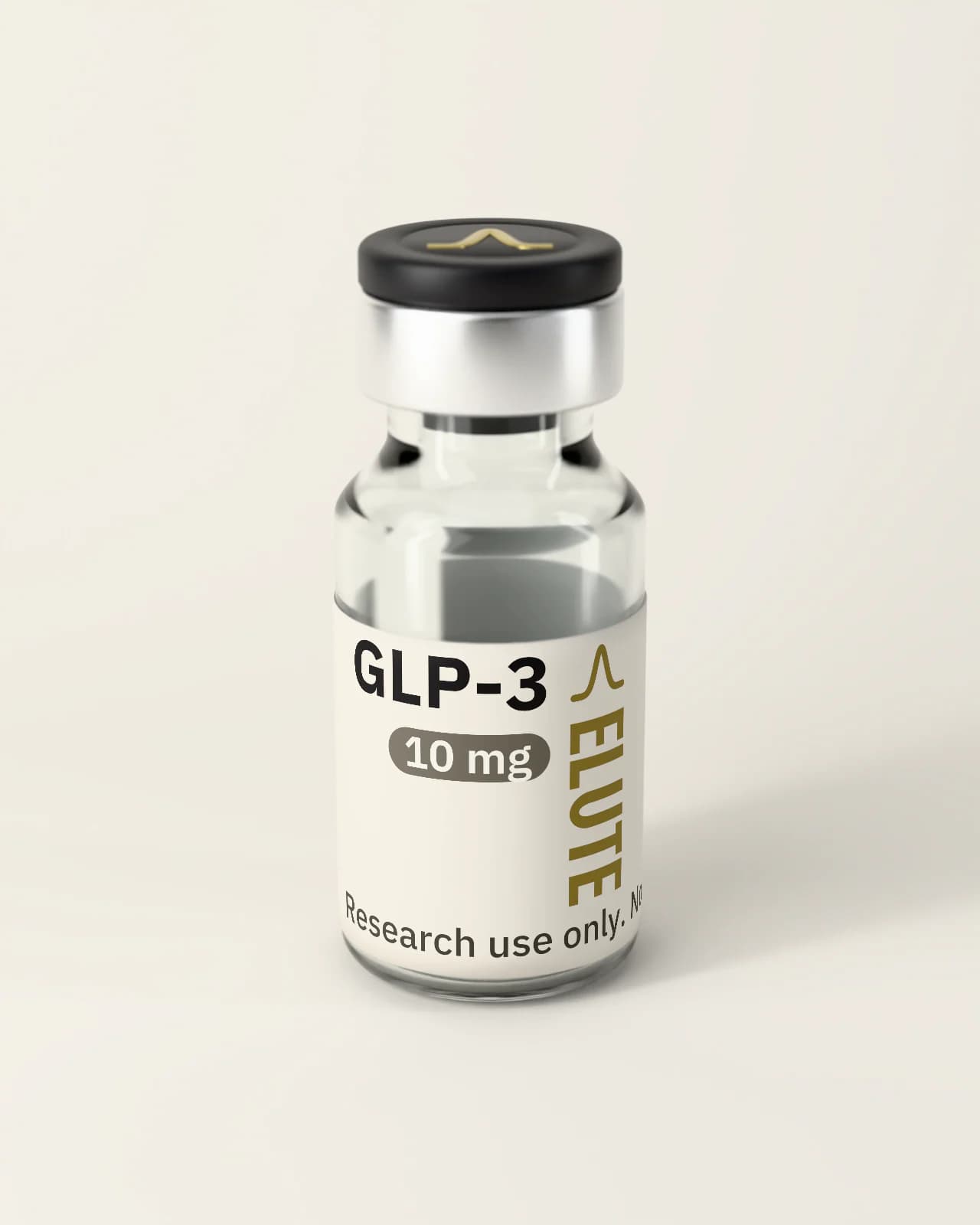
GLP-3 10 mg vial with its printed label

Research profile

GLP-3

INN retatrutide

Research topics, not use categories.

  • In vitro: 1
  • Animal: 0
  • Human, observational: 0
  • Human, controlled: 1
  • Review: 0

Registered trials5, listed apart from the publications

Content reviewed October 6, 2026

View material (GLP-3 product page)
How to read this profile
In vitro
In vitro. Cell cultures, isolated tissue or cell-free systems.
Animal
Animal. Animal models; a result in an animal is not a result in humans.
Human, observational
Human, observational. Observations in people without a controlled comparison group.
Human, controlled
Human, controlled. Studies in people with an assigned control group.
Review
Review. A synthesis of published literature, not new data.

Overview

In plain English

GLP-3 is the name this store uses for retatrutide, a synthetic peptide of 39 amino acids with a fatty side chain attached. It is a compound under development by a pharmaceutical company (called the developer here) and is not an approved medicine.

This profile summarizes only two publications. One is a laboratory study in strips of human heart tissue (right atrium) obtained during heart surgery, in which the compound increased the force with which the tissue contracted. The other is a 48-week randomized trial in 338 adults, funded by the developer and controlled with a placebo (an inactive comparison); its main results are not summarized here, but the most common adverse events were gastrointestinal, such as nausea, and heart rate rose during the first 24 weeks.

The published human research is larger than this profile: other trials funded by the developer have been published, including, in September 2026, a peer-reviewed report of one of its large registered trials (TRIUMPH-1). Their results are not summarized here. Registered trials are listed separately, by their registry entries.

The most important limitation is that the heart-tissue result comes from isolated tissue in a laboratory bath and does not show what happens in the intact heart, and that every published human trial located was funded by the developer.
Key findings from published research

Selected observations from the publications listed in this profile, which are a curated subset of the literature, not all of it. Each one names the system it was observed in and links its source; a finding in cells or animals is not a result in people.

  1. In vitro

    In strips of human right atrium obtained during cardiac surgery, retatrutide increased the force of contraction in a concentration- and time-dependent manner, more strongly when the PDE3 inhibitor cilostamide was present; antagonists at its three receptors reduced the effect, while the beta-blocker propranolol did not.

    (Neumann et al. · 2026 · PMID 40613938 (opens PubMed in a new tab))

    Limits: Isolated tissue from patients taking cardiac medication; the intact heart, the sinus node and ventricular tissue were not studied.

  2. Human, controlled

    In a 48-week randomized, double-blind, placebo-controlled trial in 338 adults funded by the developer, the most common adverse events were gastrointestinal and more frequent at higher exposure, and heart rate rose with exposure, peaking at 24 weeks and declining thereafter.

    (Controlled study in humans · 2023 · PMID 37366315 (opens PubMed in a new tab))

    Limits: The trial's primary and secondary endpoints are not summarized in this profile.

Identifiers

Name
GLP-3
Scientific name
INN retatrutide
Synonyms
retatrutide
Sequence
Tyr-Aib-Gln-Gly-Thr-Phe-Thr-Ser-Asp-Tyr-Ser-Ile-αMeLeu-Leu-Asp-Lys-Lys(R)-Ala-Gln-Aib-Ala-Phe-Ile-Glu-Tyr-Leu-Leu-Glu-Gly-Gly-Pro-Ser-Ser-Gly-Ala-Pro-Pro-Pro-Ser-NH2 · 39 residues; Aib: 2-aminoisobutyric acid; αMeLeu: 2-methyl-L-leucine; R: N6-{2-[2-(2-{[N-(19-carboxynonadecanoyl)-L-γ-glutamyl]amino}ethoxy)ethoxy]acetyl}
Molecular formula
C221H342N46O68
Molar mass
4731.3 g/mol
CAS number
2381089-83-2
UNII
NOP2Y096GV

Evidence

Human, controlledHuman, observationalAnimalIn vitro2 listed publications· 5 registered trials

Human, animal and in vitro evidence are kept apart: where a result was observed decides what it can say. In vitro covers cultured cells and tissue studied outside the body. Reviews are listed under Publications; registered trials are listed below, apart from the publications.

Human evidence

Human, controlledHuman, observational1 listed publication

The human trial listed in this profile is a randomized, double-blind, placebo-controlled trial of 48 weeks in 338 adults, funded by the developer and published in 2023; its primary and secondary endpoints are not summarized in this profile. In it, the most frequently reported adverse events were gastrointestinal (nausea, diarrhea, vomiting and constipation), were mostly mild to moderate and occurred more often in higher-exposure groups, and heart rate increased with exposure, peaking at 24 weeks and declining thereafter. Other published human trials exist and are not listed here, among them the peer-reviewed report of the registered trial TRIUMPH-1, published on September 29, 2026. All the published human trials located were funded by the developer, with company employees among the authors, and no independent human trials were located. Registered trials are listed separately, by their registry entries: TRIUMPH-1, whose results have been published in peer-reviewed form; three further large placebo-controlled trials, whose topline results the developer has announced but which had not been published in peer-reviewed form at the review date; and the registry entry of the listed trial. The developer's announcements are not peer-reviewed and are not summarized in this profile.

Listed publications at this level

Animal evidence

Animal0 listed publications

Animal studies are not summarized in this profile. The indexed literature includes rodent studies from the developer's discovery work and from independent groups. Findings in rodents do not allow inferences about effects in humans.

No animal study is listed in this profile.

In vitro and isolated-tissue evidence

In vitro1 listed publication

The in vitro evidence summarized in this profile is one study by an academic group without affiliation to the developer, in right atrial preparations obtained from 29 patients during cardiac surgery: retatrutide increased force of contraction, an effect that was reduced by selective antagonists of each of its three receptors and persisted under β-adrenergic receptor blockade. The developer's characterization of the compound in cell systems and structural or ligand-binding studies are not summarized. Cell systems and isolated tissue do not reproduce the pharmacology of a whole organism.

Listed publications at this level

Registered trials

5 registered trials

Registry entries, listed apart from the publications and not counted with them. Each links to its ClinicalTrials.gov record and shows only the registered phase, design, enrollment and status, and where its results stand. Results announced by a sponsor are marked as not peer-reviewed and are not summarized here.

Scientific detail

The technical layer: molecular identity, the mechanisms investigated with the evidence level at which each was observed, and the limits of the evidence. The plain-English summary is under Overview.

Molecular summary

Retatrutide is a synthetic peptide of 39 amino acid residues. It incorporates non-proteinogenic residues and a side chain bearing a fatty diacid (see identifiers). It is a compound under study and not an approved medicine.

This profile lists one in vitro study, in isolated human atrial tissue, and one peer-reviewed controlled human trial whose endpoints are not summarized; other in vitro studies, animal studies and other published human trials are not summarized. Registered trials are listed separately, by their registry entries only. This profile presents published scientific literature as research context and contains no directions for use.

Mechanisms investigated

Mechanistic hypotheses and observations as they were studied. The evidence level shows where each one was observed; none has been shown in people.

  1. 01Inotropic effect in isolated human atrial tissue and cAMP signaling

    In vitro

    In right atrial preparations obtained during cardiac surgery, an academic group without affiliation to the developer observed that retatrutide increased force of contraction in a concentration- and time-dependent manner, with a larger effect in the presence of a phosphodiesterase-3 inhibitor. The effect was reduced by selective antagonists of its three receptors but not by propranolol, which the authors interpret as a cAMP-mediated action through those receptors rather than through β-adrenergic receptors. The study did not examine the sinus node, so it does not show whether the heart-rate increase reported in human trials is a direct or an indirect effect.

Limitations

  • All the published human trials located were funded by the developer, with company employees among the authors; no independent human trials were located.
  • The controlled trial listed in this profile lasted 48 weeks. Longer placebo-controlled trials are registered; of those, only TRIUMPH-1 had a peer-reviewed report at the review date, and it is not summarized in this profile.
  • In the listed trial, the most frequent adverse events were gastrointestinal (nausea, diarrhea, vomiting and constipation) and occurred more often in higher-exposure groups; heart rate increased with exposure.
  • This profile summarizes one in vitro study, in isolated human atrial tissue, by an academic group independent of the developer, and no animal study; the developer's own preclinical characterization of the compound is not summarized.
  • TRIUMPH-2, TRIUMPH-3 and TRIUMPH-4 had topline results announced by the developer but no peer-reviewed publication at the review date; the developer's announcements are not peer-reviewed, and their content is not summarized in this profile.
  • Published trial data were obtained with material supplied by the developer within controlled trials; they give no information on the identity, purity or stability of material obtained through other channels.

What is not known

  • Long-term effects in humans are not established; a registered long-term outcomes trial (NCT06383390) is ongoing, with primary completion expected in 2029 according to ClinicalTrials.gov.
  • The relevance of the heart-rate increase reported in the listed trial, and whether it reflects a direct action on the heart or indirect mechanisms.
  • Whether the increase in force of contraction seen in isolated human atrial tissue also occurs in ventricular tissue or in the intact heart; the atrial study did not examine the sinus node or ventricular tissue.
  • The peer-reviewed results of TRIUMPH-2, TRIUMPH-3 and TRIUMPH-4, which had not been published at the review date.

Publications

2 listed publications

Each publication is identified by its PubMed ID or DOI and grouped by evidence level. Each heading is our own description of what was studied. Titles, authors and journals are reproduced exactly as published; when the published wording of one of them falls outside our content rules, it is not shown here, and the record links to PubMed, where it can be read in full.

Human, controlled 1

  • Human, controlledControlled study in humans· Homo sapiens

    Randomized, double-blind, placebo-controlled 48-week trial in 338 adults: endpoints not summarized in this profile

    The New England Journal of Medicine2023PMID 37366315 (opens PubMed in a new tab)Full record on PubMedDOI 10.1056/NEJMoa2301972 (opens the publisher record in a new tab)

    Registry recordNCT04881760 (opens the ClinicalTrials.gov record in a new tab)

    Model
    Randomized, double-blind, placebo-controlled trial of 48 weeks in 338 adults, with several exposure groups and a placebo group; registered as NCT04881760
    Sample size
    338
    Exposure
    Retatrutide, several exposure groups
    Comparator
    Placebo

    Trial funded by the developer, with company employees among the authors, conducted with material supplied by the developer. Its primary and secondary endpoints are not summarized in this profile; they are described in the original record. The authors report that the most common adverse events were gastrointestinal, occurred more often in higher-exposure groups and were mostly mild to moderate, and that heart rate increased with exposure, peaking at 24 weeks and declining thereafter.

    Measured endpoints

    Primary and secondary endpoints
    Not summarized in this profile; described in the original record.
    Not stated
    Adverse events
    Most commonly gastrointestinal, more frequent in higher-exposure groups and mostly mild to moderate.
    Not stated
    Heart rate
    Increased with exposure, peaking at 24 weeks and declining thereafter.
    Increase

    Limitations: Funded by the developer, with company employees among the authors; 48 weeks; material supplied by the developer within a controlled trial; the participants' characteristics and the trial's endpoints are described in the original record, not in this profile.

In vitro 1

  • In vitroIn vitro study· Homo sapiens (isolated atrial tissue)

    Isolated human right atrial preparations: force of contraction and its pharmacological modulation

    “Inotropic effects of retatrutide in isolated human atrial preparations.”

    Neumann J, Ahlrep U, Hofmann B, Gergs UNaunyn-Schmiedeberg's Archives of Pharmacology2026PMID 40613938 (opens PubMed in a new tab)DOI 10.1007/s00210-025-04421-3 (opens the publisher record in a new tab)

    Model
    Right atrial preparations obtained during cardiac surgery from 29 patients (24 men and 5 women, aged 52–84); isometric force measurement under electrical stimulation in an organ bath
    Sample size
    29
    Exposure
    Retatrutide added to the isolated tissue at increasing concentrations, with and without a phosphodiesterase-3 inhibitor (cilostamide)
    Comparator
    Force of contraction before exposure; selective antagonists of the peptide's three receptors; propranolol, carbachol, stimulation of adenosine A1 receptors and ryanodine

    Study by an academic group without affiliation to the developer. In isolated human right atrial preparations, retatrutide increased force of contraction in a concentration- and time-dependent manner; with the phosphodiesterase-3 inhibitor cilostamide present, the effect was larger and relaxation time shortened. The effect was reduced by selective antagonists of its three receptors and by carbachol, stimulation of adenosine A1 receptors and ryanodine, but not by propranolol; the authors interpret it as a cAMP-mediated action through those receptors rather than through β-adrenergic receptors. The sinus node and ventricular tissue were not examined.

    Measured endpoints

    Force of contraction in isolated human right atrium
    Concentration- and time-dependent increase, larger in the presence of cilostamide.
    Increase
    Effect of selective receptor antagonists and of propranolol
    Antagonists of the peptide's three receptors reduced the increase in force of contraction; propranolol did not.
    Decrease
    Relaxation time
    Relaxation time shortened in the presence of cilostamide.
    Decrease

    Limitations: Isolated atrial tissue from patients undergoing cardiac surgery who were receiving cardiac medication; the sinus node and ventricular tissue were not examined; the study cannot show whether the heart-rate increase reported in human trials is a direct or an indirect effect; the authors consider its clinical relevance uncertain.

For laboratory research use only. Not for human or veterinary use or consumption. Not for diagnostic use. Not evaluated by the U.S. FDA.